Friday, 24 August 2012

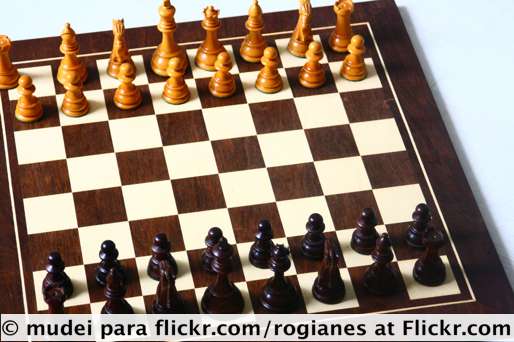
Pieces Of a Chess Set: Protect The King


Although in two player chess the King is hardly the most powerful piece (the Queen must surely take that position) he is the most precious. In any chess game rules the KIng is the piece that decides defeat, victory or even stalemate.


In the original chess game in ancient India the King was just that, a king or emperor, and above the fighting, which was carried out by the foot soldiers and generals. This once more brings chess game rules into line with military strategy; in any war, if the king is captured then it is all over. This is the case with chess and explains why the King, amongst all the pieces of a chess set, has the most limited manoeuvrability.

The King can move in any direction - horizontally, vertically or diagonally - but only one space at a time. He takes another of the chess pieces by landing on its square. Of course, the King cannot be taken but if he is put into a position where he might have otherwise been taken he is said to be put into 'Check' and he must move out of danger before any other move is made. But he can never move into a square where he would also be similarly threatened.

Of course, there comes a point when the King is in Check in the square he is now in and would be in any other square he could move into. This is then termed 'Checkmate' and the opposing player has won the game. For this reason, players frequently take care to protect their King.


Looking to buy chess sets perfect for your needs or as a gift that will never be forgotten? Visit ChessSetHeaven.com for a range of high quality themed chess sets that will suit you perfectly.

Friday, 17 August 2012

Pieces of A Chess Set: Once A Knight

You may be looking for chess sets to buy and are looking at the various themed chess sets available to buy and you might even consider a nice carved chess set. One of the pieces that that varies very little in design is the Knight (unless you are buying a Winnie the Pooh chess set, of course!).

In the original Indian Chaturanga form of chess, the Knight was shown as a mounted warrior with a sword in one hand and a shield in the other. In all the chess sets since, the Knight has had an equestrian theme with the Medieval chess sets going to town with a nice carved warrior on horseback.


Of course the Knight is unique in the way it moves. It leaps two squares up and one diagonally: it has been said this movement (also pretty well unchanged through the ages) imitates the skittish movement of a horse. This is also the only one of the pieces of a chess set that can leap over other pieces (again, an equestrian characteristic?). It takes another piece by landing on the square occupied by that piece in its final landing.

A Knight can be valuable during a game as it moves in a more unpredictable way than other pieces, although it can be threatened by Pawns if it lands amongst them. It's very erratic movement can be a weakness, as the player needs to understand where it can move next or which of the opponent's pieces threaten the Knight. For this reason many top players rate a Bishop more highly. However, a Knight may be a greater threat to a Queen, as the latter cannot take it so easily.

The movement of the Knight has lead to a mathematical pattern called 'the Knight's Tour.' This tracks the progression of the piece around a chessboard and produces a fascinating trace. Tracking the movement has become a classic challenge to set computer students. Interestingly, this pattern was first identified in India in the ninth Century and the first mathematical procedure was published in 1823.

So there you have it: the Knight is not only of historical interest but mathematical note too. And you just thought the pieces of a chess set were decorative!


Looking to buy chess sets perfect for your needs or as a gift that will never be forgotten? Visit ChessSetHeaven.com for a range of high quality themed chess sets that will suit you perfectly.

Tuesday, 14 August 2012

Pieces Of A Chess Set: The Diagonal Bishop


Continuing the look at the pieces of a chess set, this time we lean a little more about the Bishop. Sit down to have a game of two player chess and you will see this interesting piece three squares in from each corner.

The Bishop is one of the most confused pieces, as it is known by different names around the world. In the original Indian and Persian chess sets it was represented as an armed attendant sitting on the back of an elephant, indeed, the Arabic name for the piece is 'Al-fil' or 'elephant.'

As elephants in medieval Europe would not be recognised, the piece took on different identities. Many languages depict the Bishop as a 'runner' or 'messenger' ('Laufer' in German and 'Loper' in Dutch, for example) although in Romania the piece is known as 'Nebun' or crazy person.

The piece has changed names in French, originally known as the 'Aufin' (the Archer), which reflects the Arabic name and original character, it is now more known as the 'Fou' or 'fool' or 'jester.' The Spanish still use the Arabic derivation as 'Alfil' and in Russia it is still an elephant ('Slon').

Our description 'Bishop' may come from Scandinavia. The twelfth century Lewis chess set shows a churchman in this position and Iceland has long known the piece as the 'Biskup,' with the same meaning as our word bishop.

The shape of the Bishop has changed too and our modern Bishop tends to date back to the first Staunton chess set of 1849. The different names of the piece interpret its shape. The name Bishop came from the belief the piece wore a mitre but the French saw it as a jester's cap. Interestingly the groove in the top may still be a reference to the tusks of an elephant.

The movement of the Bishop has changed over the years too but the modern piece can only move diagonally. At one stage this was restricted to a few squares but now of course it can move across the whole board: this makes it one of the most valuable of the pieces of a chess set.

As with most other pieces, the Bishop cannot jump over another piece or change direction in a move and takes an opponents piece by landing on the square occupied by the victim.

So next time you settle down with your new themed chess set, you might reflect on this, one of the most interesting pieces of a chess set.


Looking to buy chess sets perfect for your needs or as a gift that will never be forgotten? Visit ChessSetHeaven.com for a range of high quality themed chess sets that will suit you perfectly.

Friday, 3 August 2012

Pieces Of A Chess Set: The Rook


When you start playing the noble game of chess and learn the chess basics, one of the pieces of a chess set that will first draw your eye is the 'Castle,' more correctly termed the 'Rook.'
 
The word Rook may at first seem an odd name for this piece, which is indeed shaped like the turret of a castle - so the word castle seems more appropriate. However the name Rook comes from the Arab name for it, which is 'Rukhkh' and the ancient Persian name was similar: 'Rukh.'
 
Rooks are almost as valuable as the Queen as they can move quickly around the board and surprise an inattentive opponent. They move up and across the board (but only one direction per move) using both the Ranks and Files but cannot move diagonally. The Rook however cannot jump over other pieces in the way a Knight can.
 
Other pieces are taken by the Rook landing on the victim's square.
 
Of course at the start of the game all the valuable pieces of a chess set are hemmed in by the Pawns but, once these are moved forward, the Rooks and other pieces are let loose.
 
The Rook is often the most likely piece to put a King into check; in fact, two Rooks working together and trapping the King in a corner is probably the classic way (and one of the simplest ways) to ensure checkmate.


Looking to buy chess sets perfect for your needs or as a gift that will never be forgotten? Visit ChessSetHeaven.com for a range of high quality themed chess sets that will suit you perfectly.

Tuesday, 31 July 2012

Pieces Of A Chess Set: The Power Of The Queen


Perhaps the most powerful of the pieces of a chess set is the Queen. The King is important to the success of the game and should always be defended but the Queen is the most maneuverable and fastest moving piece on the board.
 
She is so powerful that of all the pieces of a chess set the Queen is the only one to move in any direction. She can move any number of squares forward, backwards and diagonally. She can use any of the Files, Ranks or Diagonals; the only restriction the Queen faces is that she cannot move like the Knight or jump over another piece. Her way must be clear every time.
 
It follows of course that the Queen can also take any other piece in her path. The piece is then removed and the Queen replaces the piece by sitting on the square it formerly occupied. She can then set off in any direction on the next turn.
 
Obviously it also makes sense that one of the chess basics is to protect your Queen. As the most useful piece on the board her loss would be one of the most devastating. 
 
At the start of a game of chess each player starts with one Queen but, if a pawn makes it clear across the board, it can then be promoted to another piece and it would be unwise to exchange it for anything less significant that another Queen. The player then has two Queens, which increases the domination of the board considerably.


Looking to buy chess sets perfect for your needs or as a gift that will never be forgotten? Visit ChessSetHeaven.com for a range of high quality themed chess sets that will suit you perfectly.

Wednesday, 27 June 2012

Chess Set Pieces: The Role Of The Pawn


The game of chess, and the chess set pieces, can be back 1500 years or more and the earlier form of chess was effectively a game of war. The chess set pieces all represented warriors and their commanders - none more so than the pawn.
 
The pawn of course is the most numerous of the chess set pieces. It represents the foot soldier, the cannon fodder if you like. In any game of chess the pawns have to be moved first. In any battle, the foot soldiers have to be used if you want to capture the opponent's King or ruler.
 
When you are playing a game with your best chess set, you must also move the pawns in order to move the more valuable pieces behind. To not move the pawns would hold the other chess set pieces in position. Pawns always move forward, not back, at one square at a time unless it is the first move when the pawn can move two squares.
 
A pawn only stays in the 'file' (the line of squares leading away from the player) it starts in unless it takes one of the opposing chess pieces when it moves diagonally.
 
Each pawn is given a name depending on the chess piece behind. For example, the pawn starting in front of the King is called the 'King Pawn.'
 
Of course it is easy for a pawn to get into a stalemate simply by moving up until it faces the opposing pawn. As neither can move forward they have to wait until one of them is taken by another piece.
 
The goal of any pawn is to reach the far side of the board when this piece can be upgraded to any other piece on the board. Most people of course change it into a Queen as this is the most powerful and versatile piece on the board.


Looking to find the best chess set for your needs or as a gift that will never be forgotten? Visit ChessSetHeaven.com for a range of high quality themed chess sets that will suit you perfectly.


Thursday, 21 June 2012

Buy Chess Sets: The Chess Board


So you have found a good chess store online and have bought your chess set pieces - perhaps a good quality carved chess set. Now you come to play a game of chess and are faced with the chessboard.
 
At first sight the chessboard is simply a type of chequer board (or checker board) identical to that used by the game of Draughts (or Checkers). There are 64 squares set up in eight rows horizontally and eight vertically.
 
As with the chess set pieces, there is more to the board than you initially see. The lines of squares running away from you (front to back) are know as the 'files' and those that run right to left are the 'ranks.'
 
Already we have found the historical background to the game of chess as the terms  'rank' and 'file' are military terms used to describe the lines of troops matching. The term 'rank and file' is also used to denote members of political or trade union organisations, as an extension of the military usage.
 
Not only are the up and down rows of squares labeled but the diagonal rows of squares across the board are also know - as, er, 'diagonals.'
 
Generally a chessboard uses squares of contrasting light and dark colours. These can vary considerably, depending on the materials used to construct the board but a best chess set would be made from wood or leather and these generally use darker and lighter sheds of brown.
 
Each square tends to be between 2 to 2.5 inches (50 to 65 millimetres) in width and length: that is to say, 1.25 to 1.3 times the size of the base of the King.
 
Before starting to set up your chess set pieces, always ensure the board is orientated so each player has a white square in the right-hand corner.


Looking to find the best chess set for your needs or as a gift that will never be forgotten? Visit ChessSetHeaven.com for a range of high quality themed chess sets that will suit you perfectly.