Wednesday, 27 June 2012

Chess Set Pieces: The Role Of The Pawn


The game of chess, and the chess set pieces, can be back 1500 years or more and the earlier form of chess was effectively a game of war. The chess set pieces all represented warriors and their commanders - none more so than the pawn.
 
The pawn of course is the most numerous of the chess set pieces. It represents the foot soldier, the cannon fodder if you like. In any game of chess the pawns have to be moved first. In any battle, the foot soldiers have to be used if you want to capture the opponent's King or ruler.
 
When you are playing a game with your best chess set, you must also move the pawns in order to move the more valuable pieces behind. To not move the pawns would hold the other chess set pieces in position. Pawns always move forward, not back, at one square at a time unless it is the first move when the pawn can move two squares.
 
A pawn only stays in the 'file' (the line of squares leading away from the player) it starts in unless it takes one of the opposing chess pieces when it moves diagonally.
 
Each pawn is given a name depending on the chess piece behind. For example, the pawn starting in front of the King is called the 'King Pawn.'
 
Of course it is easy for a pawn to get into a stalemate simply by moving up until it faces the opposing pawn. As neither can move forward they have to wait until one of them is taken by another piece.
 
The goal of any pawn is to reach the far side of the board when this piece can be upgraded to any other piece on the board. Most people of course change it into a Queen as this is the most powerful and versatile piece on the board.


Looking to find the best chess set for your needs or as a gift that will never be forgotten? Visit ChessSetHeaven.com for a range of high quality themed chess sets that will suit you perfectly.


Thursday, 21 June 2012

Buy Chess Sets: The Chess Board


So you have found a good chess store online and have bought your chess set pieces - perhaps a good quality carved chess set. Now you come to play a game of chess and are faced with the chessboard.
 
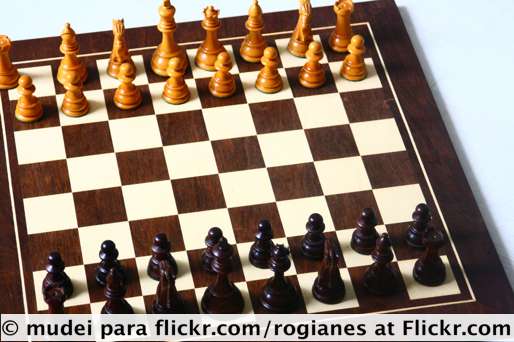
At first sight the chessboard is simply a type of chequer board (or checker board) identical to that used by the game of Draughts (or Checkers). There are 64 squares set up in eight rows horizontally and eight vertically.
 
As with the chess set pieces, there is more to the board than you initially see. The lines of squares running away from you (front to back) are know as the 'files' and those that run right to left are the 'ranks.'
 
Already we have found the historical background to the game of chess as the terms  'rank' and 'file' are military terms used to describe the lines of troops matching. The term 'rank and file' is also used to denote members of political or trade union organisations, as an extension of the military usage.
 
Not only are the up and down rows of squares labeled but the diagonal rows of squares across the board are also know - as, er, 'diagonals.'
 
Generally a chessboard uses squares of contrasting light and dark colours. These can vary considerably, depending on the materials used to construct the board but a best chess set would be made from wood or leather and these generally use darker and lighter sheds of brown.
 
Each square tends to be between 2 to 2.5 inches (50 to 65 millimetres) in width and length: that is to say, 1.25 to 1.3 times the size of the base of the King.
 
Before starting to set up your chess set pieces, always ensure the board is orientated so each player has a white square in the right-hand corner.


Looking to find the best chess set for your needs or as a gift that will never be forgotten? Visit ChessSetHeaven.com for a range of high quality themed chess sets that will suit you perfectly.
Thursday, 31 May 2012

Buy A Chess Set: Historical View of Chess - Chess, the game of kings


Chess, the game of kings, has its origins appropriately shrouded in mystery.

The chess board and it's pieces are indicative of medieval life. The six different chess pieces on the board represent a cross section of medieval life with its many ceremonies, grandeur, and wars. The castle piece on a chess board is the home, or the refuge, just as it was a home in medieval times. The pawns on the chess board represent serfs, or laborers. The is a bishop in the game of chess, who represents the church. The king is the tallest piece on the board, and is as well defended on the chessboard as in medieval life. The king is the most important, but not the most powerful piece in chess.

The squares on the chess board were all the same color until the 13th century. This afforded the players the illusion that the chessmen were floating across the board. Europe was ultimately responsible for chess' move to a checkered board.

The laws of chess and the rules governing movements of the pieces have been standard since the sixth century. It was during the 8th century in India, considered the birthplace of Chess that the game evolved to sixteen pieces on a side. In the eighth century, the Moors invaded Persia and, as the two cultures intertwined, chess became popular with the Moorish soldiers. The Muslim world, on the threshold of its greatest scientific and cultural accomplishments, welcomed chess with unbounded delight. As the Muslims expanded their empire, in the seventh through eleventh centuries, again, chess traveled with them.

When the Moors later invaded Spain, the soldiers brought the game of chess with them. The Spanish were soon also playing chess, and from there, it quickly (in historical terms) spread throughout all of Europe.
About the middle of the 15th century, the French made the single most profound change in the evolution of the game of Chess, two hundred years after Arab conquerors brought chess to southern Europe, a chess queen appear on the board. In the 16th and 17th centuries the evolution of chess took a quantum leap; the queen became the most powerful piece on the board. The queen, the only piece to represent a woman in the game of chess held a powerful yet precarious position.

From 1600-1850, it was believed that chess originated from Persia. but evidence clearly shows that chess did originate in India, rather than China or Persia as some have claimed. So by the eighteenth century chess had completely broken away from its medieval inheritance.

Since the late eighteenth century the popularity chess has increased dramatically, especially with the introduction of matches and tournaments. The current rules of chess were finalized in the early 19th century, except for the exact conditions for a draw and today it thrives as an intellectual game.

For more useful tips & hints, please browse for more information at our website:-


Looking to find the best chess set for your needs or as a gift that will never be forgotten? Visit http://www.ChessSetHeaven.com for a range of high quality themed chess sets that will suit you perfectly.

Friday, 25 May 2012

Chess Set Pieces: Opening Moves Part 2


Continuing on from the last post, here are some more pointers on how to use your chess set pieces to best advantage in the first moves:

A double move by either of the centre-pawns will have an advantageous effect for the three following reasons:

1. This double step (1 P-K4, or P-Q4) challenges the enemy forces (or chess set pieces) without taking undue risks, as the pawn remains within the line of demarcation (beyond which lies the fifth rank).

2. A central square is occupied and, if on the second move or soon after, the neighbouring pawn also advances to the fourth, we see the centre occupied!

3. A double step on the first move by the central pawn provides a free field for yet another piece, the other Bishop, as soon as the other centre-pawn shall have moved.

If we have to choose between the two opening moves: 1 P-K4, and 1 P-Q4, we must admit that 1 P-K4, is the more straightforward of the two, especially for the following two reasons:

1.    As a matter of arithmetic, this move frees four squares for the Queen (namely K2, KB3, KKt4 and KR5), instead of two in the case of the Queen's pawn (namely Q2 and Q3).

2.    Positionally, the move accelerates the development of the K side chess set pieces to bring about castling, which is technically more rapid of execution on the K side, as only two pieces have to move (Kt and B) instead of three chess set pieces on the Q side.

On the other hand, 1 P-Q4, can be considered to be more solid, which assertion is based on the fact that at Q4 the pawn is already protected (by the Queen), whereas at K4 the pawn is entirely unprotected, which may become a cause of trouble.

(from A Breviary Of Chess by S. Tartakower 1937)

So no matter where you buy a chess set or you are simply playing with your best chess set at home, taking care with you opening moves can make all the difference.


Looking to find the best chess set for your needs or as a gift that will never be forgotten? Visit ChessSetHeaven.com for a range of high quality themed chess sets that will suit you perfectly.

Friday, 4 May 2012

Best Chess Set: The Opening Moves


Have you ever sat in front of your chess set pieces with no idea how to start your game against an opponent?

No matter if you are using a cheap chess set pieces or your best chess set if you can't the best way to start a game you will somehow find the experience a disappointment.

Here are the first of some tips from 'A Breviary Of Chess' by S.Tartakower written in 1937.

It will be seen that in the original position the pieces, with the exception of the Knights, are unable to move. In order to make the deployment of the forces possible, it will be necessary to move one of the eight pawns.

Even a player who is doubtful about the wisdom of occupying the centre, will recognize that only the King's pawn and the Queen's pawn, by their slightest move, open a way to four pieces (namely King, Queen, one Bishop and one Knight), whereas a first move by any other pawn only allows one piece to move!

Although we already know that the Queen must not at first be mobilized without necessity, and the King even less so- he must be protected and not taken for a stroll - there are enough reasons left why an initial move either by the KP or the QP must be considered the best.

(To be continued)

Monday, 30 April 2012

Chess Sets Online: What Is The Attraction To Playing Chess?

 
The best way to pinpoint the reasons why playing chess games is one of the favorite pastimes of people is by looking into the characteristics of the game itself. Those characteristics will account for why people like to play this game.
 
First of all, the element that makes playing chess games different from most other games is that it is not a game of chance. The element of chance is still in it, but greatly reduced and chance will only figure in it because it is impossible to predict what the opponents move will be. That is why even in computer versions of the game, a well programmed robot will not always come out winning the game.
 
However, deliberately planned moves characterize how players play chess games. The need to coordinate one's moves with the position of the pieces on the board is paramount for success. The role of the mind in this game outweighs the role of chance, unlike other games where the results are mostly left to the roll of dice.
 
Secondly, because it is not a game of chance, the player controls his own destiny. It will only be through being unaware of options open to the opponent that one can lose the game.
 
You need great mental focus to play chess games. The kind of focus, moreover, is involved with the entire board. Gathering all the data retrieved by the eyes and consolidating their implications is important for winning the game. And this has to be done constantly in the course of the game.
 
Excellent power of memory retention are also advantageous for chess games to be won. The capacity to create and store different approaches to the play and to apply one approach when needed is necessary in chess.
 
The willingness to face challenges and to persist in spite of setbacks towards the end of winning the game is an essential psychological attribute in chess playing.
 
From all those characteristics we know that chess is attractive to people who do not like games of chance. Chess is not a game for gamblers or roulette aficionados. Chess offers a respite from the seemingly random way life proceeds. Lots of professionals and businessmen resort to a game of chess in the evening to get back the sense of logics in their lives. At the same time, because chess involves a lot of intuitive reasoning, people sometimes play it to gain inspiration for solving real-life problems.
 
People who like games that give them a great amount of control like playing chess. These will be people with realistic mind-sets. Included in this group will be professionals and businessmen who, even during their leisure time like to hone their logical powers. Playing chess is also one way of getting logic back into the thinking process. Sometimes the helter-skelter of modern life bounces the mind of the right track. Chess is one way to get back on the tracks.
 
People who like taking responsibility for their actions love to play chess games. The game is all about being responsible for your actions. At the same time, this implies that all moves should be well thought of. In this group you will have those who like managing and running things. Playing chess is one good way to improve their insight into issues. Not a few people derive inspiration for real solutions to real problems as they play chess.
 
People who want to hone their memory rentention are also motivated to play the game
 
Finally, young people who like mental challenge in their games, who are not easily discouraged and who know how to persist in attaining their goals, also play chess a lot.
 
About the Author:
John Skelly is an avid chess player and loves to not only play the game but talk about it with others. He particularly enjoys writing about the intricacies and dynamics of chess. He invites everyone to find out more about Quality-Chess.net and to play chess as often as they can.

 
Article Originally Published On: http://www.articlesnatch.com
 
 
Under Creative Commons License: Attribution No Derivatives

Monday, 26 March 2012

Chess Store: Gary Kasparov


One of the greatest chess players to pick up chess set pieces, certainly in modern times, has been Gary Kasparov.
 
Like everyone who has lives through the last years of the USSR, Kasparov has seen major changes but in many ways he has been a catalyst for some of them.
 
Born in 1963 in Azerbaijan, he started playing as early as in 1968 at the age of 5 years old. He went on to be the Soviet Junior Champion in 1976 and 1977 and World Junior Champion in 1980. Kasparov finally made it to be World Champion in 1985 (the youngest player ever to do so) and continued to dominate the world championships until 2000. He remained the world's number one player until 2006.
 
His matches against Anatoly Karpov made world news and raised the game of chess to widespread popularity.
 
In 1996, Kasparov played IBM's Deep Blue computer and the challenge was abandoned at one match each. This has to be considered in the light of the computers ability to analyze 50 billion moves of chess set pieces in three minutes: in this way you get some idea of Kasparov's abilities.
 
Away from the chessboard, Gary Kasparov has always been a leader of the anti-Communist movement, despite many threats to his life. In recent years he has appeared on television, both on advertisements and talk shows, writes for the Wall Street Journal, has authored several books on chess and it's lessons and is now a popular public speaker.
 
In 2005, Kasparov retired from using chess set pieces competitively and has now thrown himself into charity and political work. He is passionate about embedding true democracy into Russian society.
 
Find out more about this fascinating man on his website Kasparov.com.
 
Discover the best chess set for your game on ChessSetHeaven.com